Every once in awhile I am hit with one of those moments. One of those moments when I see the concrete results of what Joe and I are trying to do with our kids.
And every once in awhile, when those moments hit, my emotions run amok. Happy my child is resilient. Sad I can't do more. Pleased our parenting seems to be paying off. Frustrated that life is sometimes so hard.
All of these and more. But pride. Yes, pride, good or bad, pride is a big emotion right now.
Raising our children in the nurture and admonition of the Lord is, of course, our primary responsibility. And this particular moment hasn't to do with that part of our parenting.
Besides that eternal undertaking, in the regular day to day things, we try to raise strong and independent, resourceful kids. Kids who can stand on their own two feet come what may. Kids who will know how to survive even if something devastates our American way of life.
Simply having a big family and living on one income goes a long way in helping with that. We can't live according to mainstream society's standards. We can't provide our kids everything they want. We can't have everything we want. But we can show with our creativity and life choices how to live "outside the box." How to have a rich life in spite of doing it differently than many of our neighbors and friends.
It also means that as our kids get older, and they begin to fend for themselves, sometimes we have to let them work their way through hard times. Flounder. Come up with their own unique best way to solve the problem. Each of the four oldest has gone through such times. And each one has handled such things differently. Feelings of stress, deprivation, jealousy, even bitterness, sometimes accompany such challenges. This is adult life, right? It's a hard world.
But as every parent can attest, sometimes I just really wish I could fix everything for my kids. Many times, because of our life choices and the blessing of a large family, we simply CAN'T step in and help out. Except by simply, "being there," for them. In the long run, I hope that makes our children stronger as adults.
It is still hard, though, to watch them going through difficult times.
This little facebook interchange between Elsie and I led to one of those moments I mentioned at the beginning of the post. The kind of moment that just hits me.
Earlier in my conversation with Elsie, I'd asked her if she needed help hauling stuff home after her school year was done. She said she couldn't make any concrete plans until she got a car. I had not heard anything about car trouble. And so I asked.
Wow! It hits me right in the back of the throat. I am astounded. Astounded, humbled. This young lady hadn't even let me know she was having troubles. She is a 17 year old, living pretty much on her own, working 15-30 hours a week, while taking college classes. She is also in track.
And apparently, she's been doing this all without the use of a car. And without parental support.
(Joe said he thinks she had been talking to her Grandpa about it. Grandpa's smarter than we are in such matters anyway.)
Elsie, I'm pretty sure that not every moment in the last week or so has felt as nonchalant as your reply sounded. But I have got to say, you're quite a gal!
Love you tons.
Showing posts with label self-sufficiency. Show all posts
Saturday, May 2, 2015
Wednesday, March 4, 2015
Geeky redneck ingenuity
The right hinge on my laptop broke shortly after Christmas. I used traditional gray duct tape to hold things together. My charging cord has two bits of duct tape, one silver and one orange, at opposite ends, holding things together. My disc drive stopped working when I dug out the pre-school and kindergarten computer games for Inge a year or so ago. I guess the old Windows 98 games were too old, and so messed up my drive somehow. My screen flickers sometimes, as though it's about to give out. And there's some sort of fan problem that causes the fan to periodically stop working and the computer to shut itself down. I always try to sit with it propped up so that much air can get in.
And then yesterday my second hinge gave out.
Joe said I could probably get a non-functional case for my laptop, for about $30, and then switch out the innards into that one. But with all those other little things, and the move coming up and ensuing change in income, ... I don't really want to spend the money.
Today, when I probably ought to have been packing, I found myself challenged to do a little engineering. Home computer repair using duct tape and shoe laces. I'm pretty happy with the results. I feel sufficiently ... accomplished. I think it competes well with the steel can/2x4/duct tape cup holder Joe's dad made for our creeper van.
| view of the top; note the residual silver duct tape peeking out |
| view of the bottom, featuring the support string for the side braces |
| Note the snazzy half hitches on the laces that allow for adjusting the angle of incline |
| Just another view of my masterwork |
| One has to shape the tape around the various edge portals |
| The other edge with portals handily exposed |
| But wait, ... what about that disc drive? I know it doesn't work anyway, ... but still, ... it looks like she taped it shut? |
Wednesday, December 3, 2014
What's that in the dryer?
![]() |
| meteorites? rocks? bubble gum? |
Our dryer developed a nasty squeak over the last month. At first it was only at the beginning of the cycle, until it got warmed up. But gradually the squeak time lasted longer. And louder. Until finally this last week or so it was driving us batty.
So Joe decided it was time to take things into his own hands and see what he could see.
"You come, too, please. I want to show you what's inside there so when I'm dead and gone you will be able to fix it yourself."
"Hmmm."
I took my computer down with me, so that Joe would have handy access to various youtube videos and exploded view diagrams of the dryer innards.
But we were stymied right away. Neither of us could remember how to get the top off. We undid the screws on the back. Joe thought the next step was the top, but how? I thought the next step was the front, but how? And at first glance the internet was not very forthcoming with the information we needed. So I got back to my crochet and Joe did a little more searching.
Joe was right. The next step was the top. When he had that off, he called me down.
"Can you bring the vacuum down here and clean this lint out for me?"
Joe saw right away at least one problem. One of the plastic electrical connectors had melted at some point. Yikes! A striking proof of the providential protection of our Heavenly Father.
| melted electrical connection |
After I was done, I returned to my crochet. Joe came back down to remove the front panel.
"Can you come down and get the next section cleaned out?"
Joe went back to his pastor work while I cleaned out more lint. Handfuls and handfuls. Some of it nicely felted. Some of it simply thick pillows.
After I was done, I returned to my crochet. Joe came down and took the drum out.
"Can you come down and get the next area cleaned out?"
I once again went downstairs and cleaned out lint. This part was also a bit worrisome, since there was a thick layer of toasted lint on the back of the drum. Another striking proof of the providential protection of our Heavenly Father.
When I was done with this, Joe came back down. I did not return to my crochet, but stayed with Joe so that he could teach me all he knew about how this contraption works. Then we took the drum itself apart to get the lint from all the nooks and crannies there. We also took the little paddle things our of the inside of the drum, to clean inside of them.
All in all, we came up with about a dollar in change, a couple of foam ear plugs, several bobby pins, some candy wrappers, rubber bands, and a few other small gizmos.
And lots and lots of lint. This photo is the big chunks that didn't get sucked into the vacuum. It's hard to tell in this photo, but it fills a plastic grocery bag pretty much all the way. Notice the toasted lint on top? That's the part that was between the drum and the heating coil.
| lovely bag full of dryer lint, including some nicely toasted |
He checked online to see about the melted electrical connection pieces and decided there was no place in town that would be likely to stock that variety. But he's pretty good with electrical know-how, so he figured out a way to fix it without having to order anything. But his wire cutter tool seems to have wandered off. After making a few phone calls, Joe found one at Ryan N.'s. He sent me over to get it while he returned to his pastor work.
When I returned with the wire cutter, Joe said, "You come, too, please. I want to show you how to do it so when I'm dead and gone you will be able to fix it yourself."
Joe clipped melted pieces off, and stripped a scant half inch of plastic off the wires. This part was a little tricky, since the plastic insulation near the melted connectors had also melted, and was stuck into the bundled copper wires underneath it. But with some finagling, Joe worked them off. Then he used one of those handy-dandy twisty cap things and put the wires back together without the plastic connector pieces. He showed me how to do one wire at a time, so as to avoid reconnecting them wrongly. He even let me twist one of them together. But I did notice he kind of tugged on it after I was done to make sure it was going to stay. I didn't notice him doing that to the one he twisted.
Then we put the dryer back together: baring, drum, belt, front, top. And we started it up.
And still, it squeaked.
Time to order some parts. Joe found new bearing pieces online for about $35. He thought the heating element looked kind of sketchy and that could be ordered for $90.
That was getting close to the amount that causes one to ask if the repair is too costly. We have a ten year old dryer. A ten year old dryer originally estimated to last seven years. And a ten year old dryer originally estimated to last seven years for an average sized family.
And were there other parts that warranted replacing, too?
Joe decided on soliciting a second opinion from Kyle N.
Good news! Kyle thought every looked fine except the bearing. Even the heating element. Kyle is a tinkerer. He knows such things. What great news! A striking proof of the provision of our Heavenly Father.
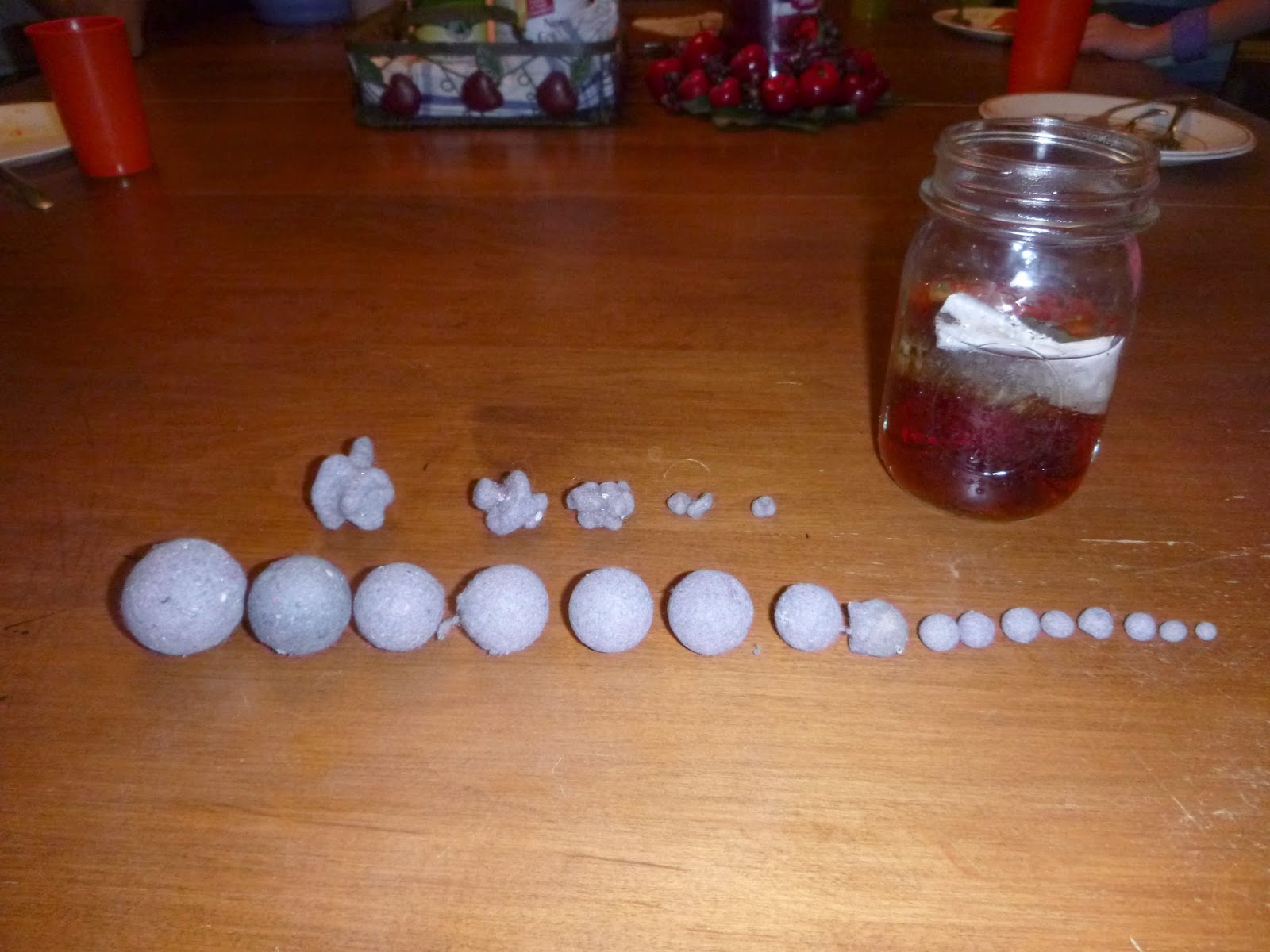
The most interesting things we pulled out of the dryer came from inside the paddle or fin things inside the drum.
The action of constant spinning combined with the shape of the inside of the fins seems to be conducive to creating unusual spheres of lint. Mostly spheres, but also some other fun shapes.
| dryer detritus |
| in order of size |
Friday, August 1, 2014
Detoured Yogurt, aka flavored homemade farm style cheese
| Clockwise from front left: Cilantro, Taco, and Garlic Basil |
"Only a small portion," is my constant theme.
So eventually, when I sense we're using too much, I try to make up a big batch. This is really an easy process, so it ought not to be a big deal. I warm the milk to about 190°F in the crockpot. I let the milk cool to blood warm. I remove a cup or so of milk from the pot and stir about 3/4 c of yogurt into the milk. When it's stirred until smooth, I return it to the crock pot and cover the whole business with a couple of thick towels or a folded quilt for about 8 hours or until I get to it. Voila'! Yogurt! Easy-peasey.
Unless I forget about it during one or another stage. And it begins to sour. Which is really a bummer, since sour milk has a different kind of sour taste than does yogurt. And my crockpot holds over five quarts.
This time I forgot about it after the warm to 190°F part. I left it cooling on the counter. But I missed the part about blood warm and left it there for a couple of days. Sigh.
But I didn't want to throw all that milk out. Dairy products can generally be used one way or another unless they have obvious mold or strangely colored bacteria colonies floating on them.
Often I simply freeze less palatable milk in smaller containers and then thaw later to use in baking. But since we had that Wal-mart milk souring issue last month, I have many, many containers of sour milk in the freezer.
So, ... what to do with the milk. It was not terribly soured. I think because of having heated it up, it slowed the souring process or something. But because of the frequency of the aforementioned sour milk episodes, my kids are especially sensitive (read: picky) when it comes to sourish milk.
I put on my thinking cap.
How about that homemade cheese I used to make when we had raw milk?
What was that recipe? Oh, well, who really needs a recipe anyway?
I once more brought the milk to about 190°F.
(An easy way to gauge this is to heat until little bubbles form around the edges, but it's not yet boiling. When I use the crockpot, it's such a large volume, that I usually give it a good stir and then wait to see if the bubbles reappear quickly. The crock pot doesn't always heat very evenly, and sometimes it's nearing the correct temp at the edges and still cool in the middle.)
And actually, I ended up simmering the milk for awhile, since I once again forgot about it. It was covered with a thick golden brown skin by the time I remembered it. That's what gives my cheeses their golden glow, rather than being a clean creamy white.
I turned off the crockpot and stirred in a cup or two of white vinegar. I don't really know how much since I didn't measure it. It was a little over an inch in the bottom of the big jug. I slooshed in the first little bit and stirred the milk mixture. It didn't feel like it was coagulating as quickly as I wanted, so I poured in the rest of the vinegar. I put the lid back on the crockpot and went to bed.
That was a couple of days ago. Finally this morning I strained off the whey. I was unsure what kind of a final product I'd find after all that forgetting.
It was good! Really good. Probably one of my best batches of homemade cheese ever.
But it was quite a large amount. So again, ... what to do with it.
"You have all these fresh herbs sitting around here, Mary," thought I. "Why don't you do something with them."
I ended up with about 2 quarts of curds.
- About 3 cups with a handful of minced cilantro.
- About 3 cups with taco seasoning mix and salt. This was supposed to be a smaller amount, but I put in too much salt, and so had to add another cup or the curds.
- That left me with about 2 cups into which I stirred minced garlic and basil.
Monday, July 8, 2013
Link to Updates from Recruit Abrahamson, and an update on the fundraiser
I posted the latest news from San Diego on the fund raising blog. You'll also find some fun quotes from donors on the, "Notes from friends and family," section.
The fundraising effort has stagnated a little. Perhaps the holiday weekend. Perhaps the initial interest in our cause and the passing it around is over. Times are hard for everyone. I totally appreciate all that everyone has done to help us out.
Our friend, Sudesh, when he heard that our chance of attending Matt's Marine Corps graduation was looking slim, offered to spearhead this fund drive. At first, we hemmed and hawed. Although Sudesh has assured me that in Hindu traditions, begging is a noble profession, since it ties the members of the community together, Joe and I did not grow up within such cultural norms. For me, it does not feel noble. It feels kind of like Joe and I, 1) are too disorganized to handle our affairs efficiently, which is true; and 2) expect others who likely struggle with their own living expenses and to give their own kids a few extra things, to give to us also. Which is not true.
We eventually said yes because, as Sudesh encouraged us, it gives those who are able to help, and who want to help, a way to do it. It lets people know there is a need. He wrote recently, "Please understand that I am doing this for a very selfish reason. It feels great to be part of your family. We show our love by these efforts and I feel very grateful that Joe and you have given us this unique opportunity to serve you and your family. You are giving us great pleasure by letting us be part of a fun experience. I suspect most of your friends and family are getting this pleasure too."
We don't at all consider it selfish, Sudesh. We're very appreciative of your concern for us, and of all your efforts, and the efforts of those others involved. We in no way expect others to come to our rescue, or to give unwillingly. Really, really, we don't want anyone feeling any obligation to give.
Please continue to circulate the website for the U.S. Marine Grad Project. Maybe there's somebody out there just waiting to help someone like us. If enough moneys are raised, we hope to continue this effort to help other needy families in the future. It would make a good family project to keep this going into the future, with proceeds from some sort of sale or other effort each year going toward helping a local family of a recruit get to San Diego for graduation.
Regardless of what happens with the fund raiser, we know that God is good. God knows what is best, and what He will eventually allow to be. We know He has our best interests at heart.
I'm currently working on our church's VBS curriculum. As background for the lessons I'm preparing, I've reread the stories of the life of Joseph in Genesis (chapters 37, and 39-50).
Joseph was the favorite son of Jacob. This obvious favoritism garnered his brothers' hatred and jealousy. Eventually, they threw him in a pit, and when the Midianite traders happened by, Joseph's brothers sold him into slavery in Egypt.
But God was with Joseph. God gave him a good master in Potiphar, and allowed Joseph to rise to prominence among Potiphar's servants. But this, too led to more hardship, since it attracted the wrong kind of attentions from Potiphar's wife. Joseph fled from her with these well-known words, "How can I do this great wickedness and sin against God?" But she, in her frustration, falsely accused him to Potiphar. And so Joseph ended up in prison.
Here again, God caused Joseph to rise to prominence among the prisoners and jailers. He gave Joseph the gift of interpreting dreams, which after a long wait led to the attention of the Pharaoh.
Pharaoh put Joseph in charge of saving food for the land from the good years, in order to combat the famine in the following years of drought. Through this, Joseph's brothers came to buy grain in Egypt, and eventually the family was reunited. Many people's lives were spared during lean years. And God used the family's generations in Egypt to further His will in Canaan, the land that He was preparing for them. Joseph said to his brothers, "You intended ill toward me, but God intended good."
God's hand is apparent in all this history.
Financial hardship is nothing nearly as troublesome as all the things Joseph went through. I know God will provide for us what we need. I don't know yet whether He has it in His plans to allow our family to travel together to Matt's Marine Corps Recruit Training Graduation. That remains to be seen.
But I do know that He will work through all the blessings of this fund raiser to work His will. I need not depend upon myself to solve all these things. I need not worry or doubt. I need not depend upon this effort to be the end-all of my well-being or that of my family. We have eternal salvation through faith in Jesus. Matt has this same gift. Under that umbrella, everything is good.
My friend, Lisa, shared this quote from Jeremiah with me a few years back and it's become one of my favorite. The later verses are so full of comfort and hope. And the first verses serve as a reminded of what happens when I focus my trust on things other than God.
Jeremiah 17:5-8
Thus says the Lord:
“Cursed is the man who trusts in man
And makes flesh his strength,
Whose heart departs from the Lord.
For he shall be like a shrub in the desert,
And shall not see when good comes,
But shall inhabit the parched places in the wilderness,
In a salt land which is not inhabited.
“Blessed is the man who trusts in the Lord,
And whose hope is the Lord.
For he shall be like a tree planted by the waters,
Which spreads out its roots by the river,
And will not fear when heat comes;
But its leaf will be green,
And will not be anxious in the year of drought,
Nor will cease from yielding fruit."
Friday, June 28, 2013
Redneck or Ingenious; Hillbilly or Creative Genius
A fun little glimpse into the world of Mary and Joe. Hope it makes you smile.
Monday, April 15, 2013
Quick and Healthful Soup for Sick Days
I've had sick kids for days. The last two days were spend with my two youngest hanging their heads in buckets. By the time today rolled around, they were so puny. Just wimpy looking, flaccid skin and muscle tone. They could hardly hold up their little cups to sip their drinks.
Besides that, theMom was pretty much at the end of her stamina, too. Simply no more energy to wring out of me. I had nothing left to give.
Which left us in a situation in which I felt we needed a good healthful meal, but had no energy to produce one. With stocked up ingredients and a little creativity, however, we ended up with a fabulous and hopefully nutritive soup.
I'm not sure I could come up with a good name for it, since the ingredients are so, well, strange. Probably the best I could do is Elk and Onions in Beef Bone Broth, with Spaetzle and Carrots.
Easy Healthy Soup, aka Elk and Onions in Beef Bone Broth, with Spaetzle and Carrots
Prepare your spaetzle batter while the soup simmers. (See below)
Mix together:
When veggies are nearly done, add spaetzle to soup by putting through a potato ricer with largish wholes. Stir. Bring to simmering and reduce heat to just maintain a simmer. Cover. Cook for about 5 minutes.
A few things I will do differently next time:
1) I forgot to salt my broth until the very end. So the spaetzle was a bit bland. When we make broth, we cook up the bones into infinity, and then strain through cheesecloth. Then we let it sit overnight and skim most of the fat off before canning. (We do use the fat, but Joe has read fat can effect the seal in home canning, so we use or preserve it separately.) After the fat is off, Joe pressure cans the broth.
2) I perused a few other spaetzle recipes, and I think next time I will add more eggs and cut the milk some. These were more fluffy than chewy. The spaetzle I've really liked in the past is chewier, more dense.
3) I will add more broth. We all got broth the first helping. But after that, what remained was more like stew.
Even without these suggested improvements, the soup was terrific. It was very fun to see the kids all taking seconds and third, and even fourths. And the two littlest sickies both ate a small portion eagerly.
What more can a mom ask for, right? A nutritive meal that took less than 1/2 hour to prepare.
Besides that, theMom was pretty much at the end of her stamina, too. Simply no more energy to wring out of me. I had nothing left to give.
Which left us in a situation in which I felt we needed a good healthful meal, but had no energy to produce one. With stocked up ingredients and a little creativity, however, we ended up with a fabulous and hopefully nutritive soup.
I'm not sure I could come up with a good name for it, since the ingredients are so, well, strange. Probably the best I could do is Elk and Onions in Beef Bone Broth, with Spaetzle and Carrots.
Easy Healthy Soup, aka Elk and Onions in Beef Bone Broth, with Spaetzle and Carrots
- Three medium onions
- Celery with leaves. I used about an inch and a half diameter of the center of a stalk.
- A hefty splash of olive oil
- Three to four quarts of your choice of broth. Homemade bone broth is great if you have it. We have canned home made beef bone broth on hand. It's more of a concentrate, really. I used 2 pints of broth and diluted each with about 3 pints of water.
- salt to taste
Prepare your spaetzle batter while the soup simmers. (See below)
- When veggies are about halfway softened, add 1 bag of frozen carrots. (If you don't have frozen, you can add fresh with the onions and celery; or canned at the end with the meat.)
- When the veggies are almost done cooking, add your spaetzle. Cook according to instructions below.
- When spaetzle is done cooking, remove from heat and add 2 cups of your choice of cooked meat. I used a pint of canned elk.
- Stir in your choice of herbs and spices. I used parsley, oregano, black pepper, and sage, to taste. I don't measure, but perhaps 1 T parsley, 1 T oregano, 3/4 t black pepper, and 1/4-1/2 t sage.
Mix together:
- 3 c GF flour mix
- 3/4 tsp xanthan gum (unless your mix already includes it)
- 3/8 tsp salt
- 3 egg
- 1 c milk
When veggies are nearly done, add spaetzle to soup by putting through a potato ricer with largish wholes. Stir. Bring to simmering and reduce heat to just maintain a simmer. Cover. Cook for about 5 minutes.
A few things I will do differently next time:
1) I forgot to salt my broth until the very end. So the spaetzle was a bit bland. When we make broth, we cook up the bones into infinity, and then strain through cheesecloth. Then we let it sit overnight and skim most of the fat off before canning. (We do use the fat, but Joe has read fat can effect the seal in home canning, so we use or preserve it separately.) After the fat is off, Joe pressure cans the broth.
2) I perused a few other spaetzle recipes, and I think next time I will add more eggs and cut the milk some. These were more fluffy than chewy. The spaetzle I've really liked in the past is chewier, more dense.
3) I will add more broth. We all got broth the first helping. But after that, what remained was more like stew.
Even without these suggested improvements, the soup was terrific. It was very fun to see the kids all taking seconds and third, and even fourths. And the two littlest sickies both ate a small portion eagerly.
What more can a mom ask for, right? A nutritive meal that took less than 1/2 hour to prepare.
Labels:
Family life,
Food,
GF cooking,
health,
homemaking,
NT recipes,
self-sufficiency
Wednesday, January 9, 2013
Burnt Fingers and Tongues
Joe and I were just snitching nibbles off the cracklings we got off the pig he and Joe Walton butchered on Saturday. I burned my fingers and tongue. It reminded me of the section in the first chapter of Little House in the Big Woods about butchering.
Pa owned a pig. It ran wild in the Big Woods, living on acorns and nuts and roots. Now he caught it and put it in a pen made of logs, to fatten. He would butcher it as soon as the weather was cold enough to keep the pork frozen.I'm pretty sure Joe and Joe did not blowup the bladder for a balloon; nor did they roast the tail over the fire. And I am very, very sure I will not be cleaning any head to make head cheese. Sorry. Nope. I do many things now I never though I would. There are also many things I thought I might like to try which I've realized I probably won't really feel like doing if the opportunity arises. Then come those things that I realize might be useful and important at some point in the future. In the post-apocalyptic world. That's where head cheese falls in my book. And I'm going to wait until then to try it.
in the middle of the night Laura woke up and heard the pig squealing. Pa jumped out of bed, snatched his gun from the wall, and ran outdoors. Then Laura heard the gun go off, once, twice.
When Pa came back, he told what had happened. He had seen a big black bear standing beside the pigpen. The bear was reaching into the pen to grab the pig, and the pig was running and squealing. Pa saw this in the starlight and he fired quickly. But the light was dim and in his haste he missed the bear. The bear ran away into the woods, not hurt at all.
Laura was sorry Pa did not get the bear. She liked bear meat so much. Pa was sorry, too, but he said:
"Anyway, I saved the bacon."
...
Then one day Uncle Henry came riding out of the Big Woods. He had come to help Pa butcher. Ma's big butcher knife was already sharpened, and Uncle Henry had brought Aunt Polly's butcher knife.
Near the pigpen Pa and Uncle Henry built a bonfire, and heated a great kettle of water over it. When the water was boiling they went to kill the hog. Then Laura ran and hid her head on the bed and stopped her ears with her fingers so she could not hear the hog squeal.
"It doesn't hurt him, Laura," Pa said. "We do it so quickly." But she did not want to hear him squeal.
In a minute she took one finger cautiously out of an ear, and listened. The hog had stopped squealing. After that, Butchering Time was great fun.
It was such a busy day, with so much to see and do. Uncle Henry and Pa were jolly, and there would be spare-ribs for dinner, and Pa had promised Laura and Mary the bladder and the pig's tail.
As soon as the hog was dead Pa and Uncle Henry lifted it up and down in the boiling water till it was well scalded. Then they laid it on a board and scraped it with their knives, and all the bristles came off. After that they hung the hog in a tree, took out the insides, and left it hanging to cool.
When it was cool they took it down and cut it up. There were hams and shoulders, side meat and spare-ribs and belly. There was the heart and the liver and the tongue, and the head to be made into headcheese, and the dish-pan full of bits to be made into sausage.
The meat was laid on a board in the back-door shed, and every piece was sprinkled with salt. The hams and the shoulders were put to pickle in brine, for they would be smoked, like the venison, in the hollow log.
"You can't beat hickory-cured ham," Pa said.
He was blowing up the bladder. It made a little white balloon, and he tied the end tight with a string and gave it to Mary and Laura to play with. They could throw it into the air and spat it back and forth with their hands. Or it would bounce along the ground and they could kick it. But even better fun than a balloon was the pig's tail.
Pa skinned it for them carefully, and into the large end he thrust a sharpened stick. Ma opened the front of the cookstove and raked hot coals out into the iron hearth. Then Laura and Mary took turns holding the pig's tail over the coals.
It sizzled and fried, and drops of fat dripped off it and blazed on the coals. Ma sprinkled it with salt. Their hands and their faces got very hot, and Laura burned her finger, but she was so excited she did not care. Roasting the pig's tail was such fun that it was hard to play fair, taking turns.
At last it was done. It was nicely browned all over, and how good it smelled! They carried it into the yard to cool it, and even before it was cool enough they began tasting it and burned their tongues.
They ate every little bit of meat off the bones, and then they gave the bones to Jack. And that was the end of the pig's tail. There would not be another one till next year.
Uncle Henry went home after dinner, and Pa went away to his work in the Big Woods. But for Laura and Mary and Ma, Butchering Time had only begun. There was a great deal for Ma to do, and Laura and Mary helped her.
All that day and the next, Ma was trying out the lard in big iron pots on the cookstove. Laura and Mary carried wood and watched the fire. It must be hot, but not too hot, or the lard would burn. The big pots simmered and boiled, but they must not smoke. From time to time Ma skimmed out the brown cracklings. She put them in a cloth and squeezed out every bit of the lard, and then she put the cracklings away. She would use them to flavor johnny-cake later.
Cracklings were very good to eat, but Laura and Mary could have only a taste. They were too rich for little girls, Ma said.
Ma scraped and cleaned the head carefully, and then she boiled it till all the meat fell off the bones. She chopped the meat fine with her chopping knife in the wooden bowl, she seasoned it with pepper and salt and spices. Then she mixed the pot-liquor with it, and set it away in a pan to cool. When it was cool it would cut in slices, and that was headcheese.
The little pieces of meat, lean and fat, that had been cut off the large pieces, Ma chopped and chopped until it was all chopped fine. She seasoned it with salt and pepper and with dried sage leaves from the garden. Then with her hands she tossed and turned it until it was well mixed, and she molded it into balls. She put the balls in a pan out in the shed, where they would freeze and be good to eat all winter. That was the sausage. from Little House in the Big Woods, Laura Ingalls Wilder.
Labels:
Books,
Food,
history,
homemaking,
humor,
self-sufficiency
Sunday, November 11, 2012
Wonderfully Restful and Productive Sunday
Roads were surprisingly good this morning, after a couple of days of sleety yuckiness sitting over our area. We got to have church this morning here at Oak Park. Mt. Olive yesterday (20 miles south of here), and St. Petri this morning (35 miles north of here and at an early 8:00 am) cancelled. But Nazareth and Oak Park (which are at 9:45 and 11:00am, and both right here in the neighborhood) were able to have services. It's always a bit stressful to Joe to have to help decide when to cancel and when to venture forth. I'm glad we had opportunity to be fed with God's Word.
We came home to homemade soup made with bear bone broth, home canned elk, a variety of left-overs and some fresh vegies, and herbs and spices. It was accompanied by two loaves of freshly baked GF bread, along with raw honey, some pepper jelly from a friend, and some of Joe's choke cherry jelly.
An extra bonus that added to the "feel good" impression of the meal was that the left-overs in the soup, too, were fun. They were so filled with homemade goodness. I used remnants of two hotdishes. The meat in one was a corned venison roast Joe cured two falls ago. The meat in the other was the meat pickings from the beef bone broth we cooked up last week. I bet there were 40-50 beef soup bones in that batch of broth. So even just the pickings was enough for two hotdishes.
All in all, it was an excellent lunch. The kids all ate the soup without complaint; and we filled in the edges with many slices of the still warm homemade bread and toppings.
At the end of the meal, Sharol Johnson came over with Clara's deer, so Joe excused himself to help hang it in the garage. When the men returned, sure enough as he is wont to do, Sharol had a bag of candy for the kids, so everyone got to choose a piece for the afternoon. Then we put the rest away. Sophie had made some fudge-like concoction yesterday from which we all also had a nibble.
After lunch, the kids did some outside chores. Matt came home from hunting with a load of left-over food stuffs that was apparently his portion from what got divvied up.
A little while later, Sharol returned asking which of the kids wanted to go out and sit with him in the deer stand. Clara had gotten hers the other afternoon hunting with him, and Sophie had yet to get one, so she went with him. Elsie and Joe headed out a little bit later. We have only three deer hanging in the garage right now. One is a good sized doe; the other two are yearlings, a buck and a doe. So really, that meat will not last us very long. North of here, in the area of Joe's St. Petri church, the firearm season goes another week yet, so it's possible Joe, or Joe and a couple of the kids, could find someone's land up that way on which to fill out their limits.
Brief Update on my depression
I don't want to ramble on about this too much, because I have several more detailed blog posts rattling around in my head that one day I may or may not put to the virtual paper. But I do want to rejoice a little bit, and ask you to join me in thanking God.
Really, it's so amazing to me how different I feel than I did six months ago, or even six weeks ago when I had a little "relapse" precipitated by all the stress and busyness of the last weeks of August and first weeks of September. It took me about four to six weeks to get my feet under me after that physical and emotional drain. But when I stop to think about things, when I compare myself to my last winter's self, or even the winter before that, really, I praise God for the healing He's allowed me.
Sunday has always been my Day of Rest. Besides the opportunity to rest and refresh my soul with the spiritual gifts of Word and Sacrament, I have made it my own little personal tradition to do next to nothing on Sundays. I try to have dinner started or at least prepped before church, so it can be put together quickly afterwards. After dinner is done, I'm done. That's it for the day, except a bare minimum of parenting responsibilities. Occasionally when I have energy enough, we might do a family activity such as an outdoor outing, or jigsaw puzzles, or games, or crafts. But anything like that is very rare the last several years. I simply ran out of oomph.
But today, TODAY! I have folded three loads of clothes and switched the wash; I will soon do the lunch dishes for my kids, since I agreed to do that so that they could get the outdoor chores done. And I have energy for it. I don't feel wiped out. I even feel rested! Isn't that strange?
And I made bread this morning. That in itself is amazing. I had oatmeal soaked for breakfast, so after my first cup of coffee, I got up and turned the oats onto medium-low heat, to come slowly to a simmer. While that was heating, I was able to think clearly enough that even with the kids buzzing around my feet and kitchen, I was able to double a recipe; and convert the basic ingredient, GF flour blend, to correct proportions of separate flour and meal components, since I currently have no GF flour mix done up. Things in my brain have been so muddled that concentration is difficult to achieve and fleeting once I can manage it.
That may not sound like a big deal to anyone who has their head screwed on straight. But it's been years since I've been able to do that. Really. At least two years, since I was able to double, convert, and mix up a recipe if my kids were around. Or if I had to summon the energy to accomplish something that took such thinking, I was wiped out afterwards for half a day at least. And here I am this afternoon, still energetic and clear headed! Truly, this is a gift of God. I cannot suitably express my excitement at this landmark!
So praise God with me,friends!
And if you are struggling through a low spot, take heart. God can and will bring you out, according to His will and timing; with or without medicinal intervention, natural treatments, or depending upon whatever course of action you prayerfully decide. He will never leave you or forsake you. And He indeed knows when best to give His gifts.
I can't help but exclaim inwardly with the Psalmist David,
The Lord is merciful and gracious,
Slow to anger, and abounding in mercy.
He will not always strive with us,
Nor will He keep His anger forever.
He has not dealt with us according to our sins,
Nor punished us according to our iniquities.
For as the heavens are high above the earth,
So great is His mercy toward those who fear Him;
As far as the east is from the west,
So far has He removed our transgressions from us.
As a father pities his children,
So the Lord pities those who fear Him.
For He knows our frame;
He remembers that we are dust.
Labels:
depression,
Family life,
Food,
GF cooking,
homemaking,
NT recipes,
self-sufficiency
Wednesday, September 26, 2012
Learning to Knit Socks: Seasons 1-4 and Season 5, Days 1-7 AKA I'm glad nobody has a time lapse video of the process
Season one: Last fall
I started noticing all the cool sock yarns in the fabric stores. Most of the patterns were for knitting. I rarely knit, due to the higher risk of losing my work if the needles get jostled by little ones.
"Oh, well," thought I, "I guess I won't be using any of those cool yarns any time soon."
Season two: Early Last winter
I bought some cool yarn for Louisa to make some socks for a friend. I found out she wanted to make obnoxious socks, not nice ones. She therefore didn't want my nice sock yarn.
"Oh, dear," thought I, "I will have to figure out something to do with it."
I found some crocheted sock patterns, and didn't like them.
In a weak moment, I gave into temptation. I not only bought double pointed knitting needles, I also bought a second variety of sock yarn.
Season three: Late last winter and into spring
I kicked around and tripped over all my piles of yarn. I growled at the kids when they got into it and strewed it all over my bedroom.
"Grrrrrr," thought I. Actually that's probably what I said out loud. Sadly, my thoughts might have been a bit more colorful.
Season four: Last summer
I took the yarn out several times to look at it.
"Hmm?" thought I. "Nope, probably not going to happen any time soon."
Season five: This fall
"It's time," thought I, "to learn how to knit socks."
Days one through four:
I got out my knitting needles and some regular yarn to refresh my memory. Nothing I did worked right.
"Grrrrr," thought I.
I crocheted two scarves and a baby afghan instead.
Day five:
I opened my double pointed needles and read the pattern.
"Oh, dear," thought I. "Not today."
I put the sock knitting stuff back in the bag and tied it shut.
Day six:
I watched some videos on using double pointed needles.
I also cast on the correct number of stitches onto one needle and divided them onto the others as the beginner videos recommended.
I knit and purled the first needle, according to instructions for the k2p2 ribbing.
"I see," thought I, "why Haleigh suggested learning the Hold the thread in your left hand method."
All that switching the yarn back and forth between the teeny tiny needles, with the teeny tiny yarn, and all eight points of the dpns hanging all over the place, takes way to much time. Very annoying.
"I'm glad" thought I further, "I only have to do 1 1/2" of this k2p2 ribbing."
A little while later, I pulled everything out and put away the yarn and the dpns. I tied the bag shut once again.
Day seven:
I cast on all three of my needles. It went much better this time. I even managed to cast on the three needles separately, rather than casting on all of the stitches onto one, and then dividing them onto the others. (This is apparently a more advanced method. See, I'm improving.)
I stitched the first needle with the k2p2 pattern. When I got to the end of my needle, the pattern was off.
"Oh, well," thought I. "Keep plugging along. Your pattern's off, but at least you're learning."
I got to the end of the second needle. The pattern was further afield.
I got to the end of the third needle. Yes, even further off yet.
I put my work in the bag, but I did not take it off the needles or tie shut the bag.
Yet.
Friday, September 7, 2012
The Sweet and Slightly Tragic Tale of Two Small Girls and a Couple of Very Tiny Mice
I have a friend who has encouraged me repetitively to post my family stories on my blog rather than only on facebook. There are many of you facebook friends, therefore who may have seen this story. So if you don't want to read the extended play version, just don't click on the link, OK? And from now on, you may see more and more of such facebook stories repeated here. And perhaps even an old one or two excavated from the deep, dark depths of facebook history.
As I was sitting around today doing nothing (as most moms do all day, you know) Inge and Donna came running inside. Inge's little hands were cupped closed together as if they held an exotic treasure.
Donna yelled, "We found a baby mouse. Inge caught it!"
Joe happened to also be sitting around doing nothing. In all truth just prior to this episode, he and I had been engaged in a rare adult conversation. It turned out to be short-lived, to be co-opted by a more interesting adventure.
Joe called Inge over and peeked into her little cupped hands. Yes, within was indeed a baby mouse. Joe got Inge a small bucket into which she gently and carefully set her tiny friend.
"Will it get away?" she asked her dad.
"No, I don't think it will be able to climb the sides of the bucket. They are too slippery, and he is too little."
They watched if for awhile.
"Do you want to see it, Mama?"
"Mmmm. I'd like nothing more," is the sarcastic response that flitted briefly through my mind. But since I'm such a good mom, what came out of my mouth sounded more like, "Oh, sure. Cute! That is so cool."
And it was cool. It was a very little mouse, about an inch around and perhaps just a tad longer. Just a little round bundle of gray fur, really. With two sparkly eyes and two teeny round ears. And a little slip of a black tail, also about an inch long. I have to admit, he really was quite cute.
"I can't believe you girls caught a mouse. How did you do it."
"The cat had it first. He was catching it in his mouth, and then throwing it, and catching it again," they explained.
"Mm-hm."
Joe watched them with the baby mouse for awhile, and told them to be sure to wash with soap and water after playing with it. Joe suspected that perhaps it had a punctured lung, since he could hear a strange clicking noise when it breathed.
Pretty soon Joe left us to go to his church office. A few minutes later he came back with a little covered dish in which was another baby mouse. Funny isn't it, how the Inge can catch one with her hands, but Daddy has to use a little dish?
"Daddy, Daddy, how did you catch one? Where did you get it? Why did you bring another one in?" were some of the questions cascading from the two girls, as they hopped up and down in excitement.
"The cat had this one, too," Joe explained. "If we keep taking away any that he finds, he'll keep finding more of them, and maybe he'll eventually get the whole nest. That's why we have a cat, you know, to kill the mice for us. He's earned his keep today. So you can't keep the mice, understand? We will have to kill them. But you can watch them for a little while longer."
As the afternoon progressed, the little girls were in and out of the living room where the mice were dwelling in the tenuous security of their bucket home. Inge and Donna came and went, checking on and watching the baby mice. And then whoosh, away again, off to play elsewhere for awhile. In and out, each in its turn, as afternoon hours slipped by.
At one point, Inge was dancing with the bucket of mice, swinging it back and forth, while singing a little song. I became a bit concerned that she'd dump them out with her antics, so I suggested she take them outside to dance with them. Pretty soon she and Donna left the room, I assumed to go play outside. I thought no more of the mice.
It turned out the girls did not wish to continue to look at their little friends, and dance with them, and otherwise befriend them under the watchful eye of theMom. Unbeknownst to theMom, the girls had taken the bucket, complete with mice, into their bedroom for a more intimate interpersonal experience.
But of this further development, I remained blissfully unaware.
Eventually the older kids got home from school, with the typical rush and bustle of three kids getting off a school bus. Each had tales of the day to relate. They get home hungry and clamoring for a snack. The younger ones are always eager to show me their papers and any notes from their teachers. And the school kids, in turn, get to hear all about our day from Inge, Donna, and I. It really gets to be quite a commotion.
Since I was a little under the weather today, I still sat in the living room doing nothing. When everyone got home, I tried to stay on the sidelines of the fray, keeping mostly to myself until the initial excitement quieted down.
I heard from the other room, one of the little ones telling about the mice.
"There used to be two, but one of them kept biting us, so we smashed him."
! ? ! ? !
Of course, this is not the kind of talk I prefer to hear from my little girls. Parents walk a fine line raising kids these days. "Be kind to animals," and, "No bullying," etc. But yet at the same time, we want strong and independent kids. We want kids who know the difference between people and animals, and who if necessary, can kill their own food to provide for their families. Or kill a threatening or dangerous animal to protect themselves or others.
Yes, I realize the mice had to die. But I must admit I was a bit chagrined to hear such a calloused explanation of the demise of one of those cute little creatures.
Sentimental, yes. But, where to draw the line? I struggle with this as a mom. Where does practical end and unwonted cruelty begin? Sigh.
The final chapter in my tale occurred a short time later. The rush of the daily homecoming had subsided. The snacks were eaten. Activity had once again diminished to include only the normal hubbub of a houseful of children.
Suddenly the calm was broken by the shrill hollering of one of the bigger girls, "GROSS MOM! There's dead mouse in the hallway!"
Friday, August 24, 2012
There's Hoarders, and there's Hoarders
I hear people talk about hoarding. The reality show, Hoarders, along with others of similar vein, seem to have put the more extreme mentality of hoarding into the mainstream consciousness. And perhaps I even engage in a certain amount of hoarding. I hate the idea of throwing things into the landfill that still have materials left on them that can be reused or remade into something useful.
After going through nearly all of the totes of children's clothes I have collected throughout my nineteen years of parenting, I'm beginning to wonder if I quality as a full fledged hoarder. In my defense, I think I simply had many children to clothe and was determined to spend little or no money on the process. Because we live in a very opulent era, everyone else has much more than they need and people like to pass things on. To whom do they pass things? They look for the people who would need them most, and well, large families tend to look "needy". It's a very kind-hearted gesture. And thankfully, you wouldn't believe it if I told you how little I've spent on clothes for my kids throughout the years. But gradually, it appears, I have saved more of these gifts of clothing than I realized. Certainly more than we would ever need.
I currently have twelve very large boxes sitting in my front entry way waiting their trip to Goodwill in Grand Forks. I also have several smaller boxes of things for consignment, and various other bags and boxes to go here and there. Everyone still has a full dresser, and there are clothes packed away for most of the upcoming sizes.
So, the good news is, that I am making progress on what seemed for so long an impossibly daunting undertaking. I am very excited about all the order, and new-found space we will have once I get everything hauled out.
In between my various jobs, I take a few minutes here and there to read. I'm currenly re-reading the Ranger's Apprentice series. It's a middle school level series of adventure stories with a fictional medieval setting that is roughly based upon Europe and the surrounding areas. The main characters accupy a country called Araluen, which is somewhat comparable to England. There is also Celtica, Teutlandt, Gallica, Skandia, etc.
The Ranger Corps is a sort of intelligence group that specializes in steath, gathering information, and a mysterious set of skills that give others the impression that they are almost magical.
Right now, I'm reading book four of the series, The Battle for Skandia. In this installment, the famous ranger, Halt, and his apprentice, Will, team up with the Skandian jarl, Erak, to help the Skandians fight off an invasion by the Tumajai, who are roughly comparable to the Mongols.
Since the Skandians prefer a straightforward, bashing kind of conflict with their fearsome battle axes, they are dependent upon Halt and Will to lead them in forming some strategies to fend off the Tumajai hoards. One of the ideas, the merits of which Halt and Will are discussing, is whether they could train some of the Skandian slaves to serve as archers. These archers would be trained to release arrows at a command, which would include instructions indicating at what angle to hold the bows, in order to hit the invading armies at just the right spot.
The idea is Will's and he is waiting for Halt's reply. He is pleasantly surprised when Halt, likes the idea.
But it does interest me a bit, too, from an anthropological point of view. Are Scandinavians thought of as hoarders? Is that a personality trait stereoptype that is widespread today? It certainly fits, to a degree, with most of those among whom I live who claim Norwegian and Swedish, or even Finnish descent.
And that is not meant at all as an insult. We save and reuse and refit and refurbish until there is comparably little wasted. It's a beautiful thing!
After going through nearly all of the totes of children's clothes I have collected throughout my nineteen years of parenting, I'm beginning to wonder if I quality as a full fledged hoarder. In my defense, I think I simply had many children to clothe and was determined to spend little or no money on the process. Because we live in a very opulent era, everyone else has much more than they need and people like to pass things on. To whom do they pass things? They look for the people who would need them most, and well, large families tend to look "needy". It's a very kind-hearted gesture. And thankfully, you wouldn't believe it if I told you how little I've spent on clothes for my kids throughout the years. But gradually, it appears, I have saved more of these gifts of clothing than I realized. Certainly more than we would ever need.
I currently have twelve very large boxes sitting in my front entry way waiting their trip to Goodwill in Grand Forks. I also have several smaller boxes of things for consignment, and various other bags and boxes to go here and there. Everyone still has a full dresser, and there are clothes packed away for most of the upcoming sizes.
So, the good news is, that I am making progress on what seemed for so long an impossibly daunting undertaking. I am very excited about all the order, and new-found space we will have once I get everything hauled out.
In between my various jobs, I take a few minutes here and there to read. I'm currenly re-reading the Ranger's Apprentice series. It's a middle school level series of adventure stories with a fictional medieval setting that is roughly based upon Europe and the surrounding areas. The main characters accupy a country called Araluen, which is somewhat comparable to England. There is also Celtica, Teutlandt, Gallica, Skandia, etc.
The Ranger Corps is a sort of intelligence group that specializes in steath, gathering information, and a mysterious set of skills that give others the impression that they are almost magical.
Right now, I'm reading book four of the series, The Battle for Skandia. In this installment, the famous ranger, Halt, and his apprentice, Will, team up with the Skandian jarl, Erak, to help the Skandians fight off an invasion by the Tumajai, who are roughly comparable to the Mongols.
Since the Skandians prefer a straightforward, bashing kind of conflict with their fearsome battle axes, they are dependent upon Halt and Will to lead them in forming some strategies to fend off the Tumajai hoards. One of the ideas, the merits of which Halt and Will are discussing, is whether they could train some of the Skandian slaves to serve as archers. These archers would be trained to release arrows at a command, which would include instructions indicating at what angle to hold the bows, in order to hit the invading armies at just the right spot.
The idea is Will's and he is waiting for Halt's reply. He is pleasantly surprised when Halt, likes the idea.
Will had been waiting for his mentor to point out the fundamental flaw in his logic. Now he saw that Halt was considering his proposal seriously. Then he noticed the look of exasperation that grew on Halt's face as he found the flaw.At this point in the narrative, both Will and Halt are feeling a bit dejected. It was a great idea, but it simply will not work. But then Jarl Erak pipes up.
"Bows," the Ranger said, disappointment in his voice. "Where would we find a hundred bows in time to let people train with them. There probably aren't twenty in all Skandia."
"I could let you have a hundred," Erak said in the depressed silence that followed Halt's statement. Both the others turned to look at him.A few minutes later, we see the big Skandian jarl in a very satisfied state of mind.
"Where would you find a hundred longbows?" Halt asked him. Erak shrugged.
"I captured a two-masted cob off the Araluen coast three seasons ago," he told them. He didn't have to explain that when a Skandian said season, he meant the raiding season. "She had a hold full of bows. I kept them in my storeroom until I could find a use for them. I was going to use them as fence palings," he continued. "But they seemed a little too flexible for the job."
"Bows tend to be that way," Halt said slowly, and when Erak looked at him, uncomprehending, he added: "More flexible than fence palings. It's one of the qualities we look for in a bow."
Well, I suppose you'd know," Erak said casually. "Anyway, I've still got them. There must be thousands of arrow shafts as well. I thought they'd come in handy one day."
Halt reached up and laid a hand on the massive shoulder. "And how right you were," he said. "Thank the gods for the Skandian habit of hoarding everything."
Well, of course we hoard," Erak explained. "We risk our lives to take the stuff in the first place. There's no sense in throwing it away. Anyway, do you want to see if you could use them?"
"Excellent," he said happily, rubbing his hands together. "If you decide to use them, I'll be able to charge Ragnak."I don't know whether anyone without the context of the various personalities can appreciate this interchange as much as those of us familiar with the story line can. I love the quirky twist it adds to the character development.
"But this is war," Will protested. "Surely you can't charge Ragnak for doing something that will help defend Hallasholm?"
Erak turned his delighted smile on the young Ranger. "To a Skandian, my boy, all war is business."
But it does interest me a bit, too, from an anthropological point of view. Are Scandinavians thought of as hoarders? Is that a personality trait stereoptype that is widespread today? It certainly fits, to a degree, with most of those among whom I live who claim Norwegian and Swedish, or even Finnish descent.
And that is not meant at all as an insult. We save and reuse and refit and refurbish until there is comparably little wasted. It's a beautiful thing!
Wednesday, August 24, 2011
Brainstorming National Defense
As the title states, this is brainstorming. I've not had time to research this topic, but it's been on my mind for several years. Please share with me any further knowledge or opinions you hold.
However, many people who likewise consider themselves constitutionalists, and have studied Constitutional history more so than have I, consider a standing army as necessary to national defence, which is one of the few constitutionally assigned responsibilities of our federal government. My understanding, again with little personal study, is that a standing army became the norm very early in the history of our country, and therefore through very early precedent, is considered legitimate. If I have it straight, the idea of a standing army was the source of one of the original disagreements between those known as Federalists and those known as anti-Federalists, in the struggle for ratification of the Constitution. Since those same statesmen were involved in the continuing debate after our Constitution’s ratification, and since as soon afterwards as the early 1800s we've had a standing army of sorts, that although not part of the constitution, strict constitutionalists consider a standing army as consistent with the founding principle of national defence.
Does that make sense? Have I represented the history accurately? Really, I admit, this is poor scholarship. I'd love to do a bunch of reading today to figure it all out, but I simply have other callings.
However, I did want to get these thoughts down and hopefully elicit some discussion.
Mary's thesis for today,
This put me in mind, once again, of the militia system originally included in our founding documents, and my persistent questions about national defence and a standing army.
The way I understand it, militias were to be maintained by the states; each state in its freedom was to set up their militia according to their own needs and assets. But the states were not allowed the freedom to neglect this responsibility. I think I've read that not only were the citizens required to own firearms, they were responsible to know how to use them, and how to act together as a military force when needed. Part of the states' responsibility was to call periodic musters to train and to test the militias for readiness.
I've heard some say that the national guard is the modern rendition of the state militias. I don't buy that. Again, this is speaking off the cuff, because I've not researched it. Perhaps readers could comment? But the the primary way in which the militias are autonomous is that they have to be called out at the command of the state governors, and led by the command structure within such a state. Is that right? In case of some state disaster or national military need, must they be called out by their governor and assigned under the auspices of the particular military structures from within that state?
Further though, I believe the National Guards are set up uniformly throughout the nation, and their operation is subject to federal authority. And they certainly do not involve the broad societal training in firearm use and military tactics. Only those who choose must participate.
Are there still militias in the original sense? Groups of citizens who gather to maintain skills in firearms and military skill? I've been told there are. I've even been accused of being a militia type, since our family owns and practices the use of firearms both for putting food on the table and for maintaining the ability to defend ourselves and those around us. But we certainly don't participate in any military training exercises.
It seems as though the idea of "militia" today has become a dirty word and those who strive to maintain such skills are perceived as crazies. I've never known anyone who is part of a militia group, that I know of. Therefore, I can't defend or criticize such activities. All I know is the rumors, which seem to span a broad spectrum as far as the legality of activities, but also as to the veracity of the rumors.
But perhaps we need to explore the possibility of renewing the state militias. Perhaps there is a place for a lessening of the national military, and stronger state run militias. Could it work? Is it conceivable? I don't know. But I am interested by the thought that we've become locally weaker as our national defence is provided for us by the federal government. We've become so dependent upon the national military that many people aren't even aware of the many ways our military contributes to and defends our freedoms. We tend to just float through our days, complaining about one thing or another that is wrong with our country, with little or no thought for how peace and order are maintained both at home and abroad.
This seems to me to coincide with an attitude of, "Well, the government will do it. I probably won't like their decisions, but what can I do about it?" This is a typical symptom of dependency in all manner of nanny state issues. I believe an argument could be made that this attitude of dependence puts us at a higher risk of ever increasing federal encroachment on our individual and states' rights. I believe the founders would be appalled at the amount of freedom we've thoughtlessly conceded. And I wonder if the demise of the state militia system is an important facet of states' rights and limited national government. Not only are we ambivilent about our national defence and critical of it, we also have forfeited any ability to defend ourselves against any tyranny that would arise from within our borders.
The Congress shall have PowerAnd also,
To raise and support Armies, but no Appropriation of Money to that Use shall be for a longer Term than two Years;
To provide and maintain a Navy;
To make Rules for the Government and Regulation of the land and naval Forces;
To provide for calling forth the Militia to execute the Laws of the Union, suppress Insurrections and repel Invasions;
To provide for organizing, arming, and disciplining the Militia, and for governing such Part of them as may be employed in the Service of the United States, reserving to the States respectively, the Appointment of the Officers, and the Authority of training the Militia according to the discipline prescribed by Congress;
Article I, Section 8, of the Constitution
A well regulated Militia, being necessary to the security of a free State, the right of the people to keep and bear Arms, shall not be infringed. The Second Amendment to the Constitution.I've on occasion thought that the idea of a standing army is not in accordance with Constitutional principles. I consider myself a Constitutional Conservative. And as such, I've wondered whether a standing army is somewhat inconsistent with a strict constitutional outlook.
However, many people who likewise consider themselves constitutionalists, and have studied Constitutional history more so than have I, consider a standing army as necessary to national defence, which is one of the few constitutionally assigned responsibilities of our federal government. My understanding, again with little personal study, is that a standing army became the norm very early in the history of our country, and therefore through very early precedent, is considered legitimate. If I have it straight, the idea of a standing army was the source of one of the original disagreements between those known as Federalists and those known as anti-Federalists, in the struggle for ratification of the Constitution. Since those same statesmen were involved in the continuing debate after our Constitution’s ratification, and since as soon afterwards as the early 1800s we've had a standing army of sorts, that although not part of the constitution, strict constitutionalists consider a standing army as consistent with the founding principle of national defence.
Does that make sense? Have I represented the history accurately? Really, I admit, this is poor scholarship. I'd love to do a bunch of reading today to figure it all out, but I simply have other callings.
However, I did want to get these thoughts down and hopefully elicit some discussion.
Mary's thesis for today,
Whereas throughout the history of this sinful world, it's been shown time and again that the more a civic institution does for its citizenry, they are increasingly less inclined and eventually less able to do for themselves;I came to these thoughts this morning while reading The King's of Clonmel, Book 8 of John Flanagan's, The Ranger's Apprentice series. Will, for whom the series is named, is a former apprentice who is now a full fledged Ranger. He is now working with the other apprentices at the Rangers' annual gathering. The Rangers in the fictional Araluen kingdom, are primarily an undercover and intelligence gathering group in this feudal system of Flanagan's world. But as such, they also assist the various Lords and battle masters with strategy when the need arises. Will's assignment is to guide the apprentices in developing a strategy for a tactical exercise, according to the assets listed in the exercise. As I read today, Will reminded the apprentices of their unstated assets, such as the trained archers each village of more than 100 citizens is required maintain.
and whereas our founders had some very specific reasons for fearing a standing army;
and whereas the founders did provide us with an organized way for the states to take responsibility for their own defence and to contribute to the national defence, through the maintenance of a well regulated militia;
and whereas there is an inverse relationship between the growth of a standing army and the dwindling of state militias (which one might argue is a corollary of the first "whereas");
perhaps we who consider ourselves Constitutional Conservatives ought to find a way to justify our stance more closely to that which the founders intended.
Is not our military structure, the way it is today, a bit like socialism, in that the more the government does for us, the less we do ourselves, and then the less able we become to do for ourselves?
This put me in mind, once again, of the militia system originally included in our founding documents, and my persistent questions about national defence and a standing army.
The way I understand it, militias were to be maintained by the states; each state in its freedom was to set up their militia according to their own needs and assets. But the states were not allowed the freedom to neglect this responsibility. I think I've read that not only were the citizens required to own firearms, they were responsible to know how to use them, and how to act together as a military force when needed. Part of the states' responsibility was to call periodic musters to train and to test the militias for readiness.
I've heard some say that the national guard is the modern rendition of the state militias. I don't buy that. Again, this is speaking off the cuff, because I've not researched it. Perhaps readers could comment? But the the primary way in which the militias are autonomous is that they have to be called out at the command of the state governors, and led by the command structure within such a state. Is that right? In case of some state disaster or national military need, must they be called out by their governor and assigned under the auspices of the particular military structures from within that state?
Further though, I believe the National Guards are set up uniformly throughout the nation, and their operation is subject to federal authority. And they certainly do not involve the broad societal training in firearm use and military tactics. Only those who choose must participate.
Are there still militias in the original sense? Groups of citizens who gather to maintain skills in firearms and military skill? I've been told there are. I've even been accused of being a militia type, since our family owns and practices the use of firearms both for putting food on the table and for maintaining the ability to defend ourselves and those around us. But we certainly don't participate in any military training exercises.
It seems as though the idea of "militia" today has become a dirty word and those who strive to maintain such skills are perceived as crazies. I've never known anyone who is part of a militia group, that I know of. Therefore, I can't defend or criticize such activities. All I know is the rumors, which seem to span a broad spectrum as far as the legality of activities, but also as to the veracity of the rumors.
But perhaps we need to explore the possibility of renewing the state militias. Perhaps there is a place for a lessening of the national military, and stronger state run militias. Could it work? Is it conceivable? I don't know. But I am interested by the thought that we've become locally weaker as our national defence is provided for us by the federal government. We've become so dependent upon the national military that many people aren't even aware of the many ways our military contributes to and defends our freedoms. We tend to just float through our days, complaining about one thing or another that is wrong with our country, with little or no thought for how peace and order are maintained both at home and abroad.
This seems to me to coincide with an attitude of, "Well, the government will do it. I probably won't like their decisions, but what can I do about it?" This is a typical symptom of dependency in all manner of nanny state issues. I believe an argument could be made that this attitude of dependence puts us at a higher risk of ever increasing federal encroachment on our individual and states' rights. I believe the founders would be appalled at the amount of freedom we've thoughtlessly conceded. And I wonder if the demise of the state militia system is an important facet of states' rights and limited national government. Not only are we ambivilent about our national defence and critical of it, we also have forfeited any ability to defend ourselves against any tyranny that would arise from within our borders.
Labels:
conservatism,
constitution,
government,
guns,
self-sufficiency,
society
Friday, August 19, 2011
Preparedness
Updated 8/19/11, in order to include titles. Apparently some people
are not seeing the Amazon links. Sorry.
Do you ever wonder what you'd do if "the big collapse" happens? If the grid goes down? If life as we know it ceases to exist?
It's not really something I worry about, since I know God always provides for the "evil and the good." (Matthew 5:45) But I do think about it. I do try to make life choices that help to prepare myself and my family for such an event. Even if something like that never happens in lifetime or that of my kids, there are basic survival and creative skills that need to be passed on.
In a facebook thread tonight, on the idea of getting ride of books, this topic came up. For the reasons mentioned above, I don't ever like to get rid of "How to" books. We have many, many of them.
Here are a few of our favorites:
Eric Sloane's books are a work of art in and of themselves, but the information in these two is phenomenal. Such detail and description.
The first book, The Diary of an Early American Boy, describes designing and developing the homestead. The second is pretty self-explanatory, Museum of Early American Tools. Both books include detailed sketches of the procedures and tools being described.
Homemade Contrivances, and How to Make Them, by Skyhorse Publishing. This is so fun. It's amazing what someone can do (and without an engineering degree even!).
Joe likes Handy Farm Devices and How to
Make Them, by Rolfe Cobleigh, but I've not looked at it. I didn’t even know we had it! According to Joe, "It shows useful ways of getting things done, with materials you probably already have." He thinks this is also the one that has a section on using the carpenter's square.
I always laugh when I hear these preparedness ads for sealed meals. And how long will they last? Then what will you do? Hmmm?
It's kind of the, "give a man a fish or teach him to catch his own," thing.
After learning the techniques in Preserving Food Without Freezing or Canning: Traditional Techniques Using Salt, Oil, Sugar, Alcohol, Vinegar, Drying, Cold Storage, and Lactic Fermentation, from The Gardeners and Farmers of Centre Terre Vivante, you're one up on either of the above choices. You can be the one teaching the man to preserve his own food.
We picked up The Reader's Digest book, Back to Basics in a box of junk somewhere years ago and it's on of our favorites. It's a great introduction to potentially necessary basic skills.
I also got the Reader's Digest Complete Book of Needlework, from among Joe's grandma's things after she passed away and I love it, too. Clear and easy instructions for mastering a large variety of needlework.
The Foxfire Books are all just all-around good books describing and teaching so many useful skills by those who still practice them.
Have fun exploring the world of basic skills!
Tuesday, July 12, 2011
Begging Chickens
"Whistling girls and crowing hens Always come to some bad ends."
from Farmer Boy, by Laura Ingalls Wilder.
Although I do whistle, I've yet to hear a crowing hen. But this morning I was privileged to see a begging chicken.
After I had Matt's lunch made and had checked my e-mail and facebook for anything important, I headed out to my front porch to have my morning cup-o-joe and sit for a few minutes with Master and Commander, by Patrick O'Brian. I also snuck a peanut butter granola bar; since the big kids have been sleeping in, we don't serve breakfast until late these days. (OK, really I just snuck it because it was there. This is why I don't buy packaged foods as a rule. They have a way of calling and calling....)
When I opened the door to go out, I was greeted by both a barred rock hen and one of our cornish cross meat birds. They've taken to slipping out under the electric wire and exploring the grounds. And occasionally they even hop up our front steps. They tend to be a bit shy, so I wasn’t surprised when they both hopped back down the steps after I first poked my head out the door.
It was a bit chilly (54F), so put down my coffee and book. I came back in to grab a couple of throw blankets with which better enjoy the crisp air of a northern Minnesota morning.
I don't like cold feet, so I wrapped one blanket snuggly around my lower half, with a little extra hanging down in which to tuck my feet. The other blanket I draped around my shoulders; and so I settled in for my coffee and read. I took a few cleansing breaths as looked out on the morning I listened to its sounds. I crossed my legs and settled more comfortably into my wicker chair.
And I began to read.
The chickens had returned to the porch and were wandering around, curiously exploring the nooks and crannies among my potted plants.
After a few paragraphs I braved my coffee to test whether it was yet cool enough to drink. Alas! it was not. Sigh.
Read a few more paragraphs.
Test the coffee again.
Aah.
Now for my granola bar. Mmmm.
As I nibbled at my granola bar, and sipped my coffee, I noticed the cornish cross chicken was looking at me very intently. He came right up to my left side and just stood there looking up over the edge of my lap. I put down my book and my cup so I could give my full attention to this curious behavior. That chicken just kept staring at my granola bar and waggling his head from side to side, like chickens do, so each eye in its turn could get a good look at what that human was eating.
After several moments of him giving me the chicken version of puppy-dog eyes, Mr. Chicken moved to the other side of me, I suppose to get a different angle on the granola bar. Since I had crossed my legs, my blanket-wrapped foot was hanging at just above eye level for the chcken.
Mr. Chicken took a deep breath, spread his wings a bit, and then with a mighty flutter, he flumped his way onto my foot. (Flump, in this case, is the combination of fly and jump; because cornish cross chickens are bred to be heavy birds, they don't fly easily or gracefully.)
I giggled a little bit and just watched to see what he would do next. Soon Mr. Chicken flumped his way up to my knee.
I quickly popped the last of my granola bar into my mouth. I was not about to have to share such an indulgence with a chicken. After that, I just watched and waited.
After a little bit further exploration, he pecked a few times at my thumbnail. We've noticed that chickens like finger and toe nails; I think their slight shine must look like the iridescence on bug shells.
I was chuckling the entire time. I remember saying something like, "You better not poop on my blanket, Mr. Chicken."
Eventually, in one final attempt at making himself at home, that silly chicken plumped up his feathers and swayed a little from side to side in what gave every impression of being the chicken version of a dog's turning three times before lying down. He then proceeded to settle himself upon my knee.
I guffawed. Yes, sitting out on my front porch, nobody out there but me and the birds, and I giggled and laughed right out loud. I might have seemed a little touched had anyone happened by.
But really, that chicken reminded me for all the world of a pet dog or cat.
Or more frightening yet, is it that my lap looks so very like the soft and comfiness of a nesting box?
Labels:
animals,
Food,
humor,
outdoor life,
pets,
self-sufficiency,
summer activites
Monday, June 13, 2011
It Feels Like Arbor Day
We had a big planting day around here yesterday. Joe and I planted three currents, a disease resistant elm, a Juneberry, a lilac, and three grape vines; and we moved an apricot windbreak shrub that was looking sickly. Then I quickly poked in the rest of my annual flowers as it was beginning to sprinkle.
When we moved into our house almost ten years ago, the parsonage was only three and a half years old. The church was built in the seventies, so the trees near the church were mature. There are flowering crabs and spruce and a dwindling honeysuckle hedge on the north side of the church.
But around the new parsonage were only baby trees. There were baby poplars and spruce and willow on the north side; and between the church and the parsonage there were ash and maple and spruce. The poplars were only about five or six feet and the spruce and ash were very small, maybe only three or four feet. There was also what was left of some windbreak shrubs on the south side. I think there may have been nine that made it through our first winter here, scattered around what used to be two rows. These were mostly still in what I call the "stick" stage, the single upright stick or two with a few leaves or tiny branches.
Since then, the poplars have grown very tall, as poplars will; the spruce and willows are all over my head; most of the ash and maple are probably twenty feet tall; we combined the scattered remains of the two rows of sticks on the south side and have added to it each year. It is now complete and starting to fill in the spaces between the shrubs. We're ready to begin a second row next year.
Our first summer here, someone had given money, specifically for some shrubbery for the parsonage. So we got three arborvitae, a bridal wreath spirea, a burning bush, a lilac, a double flowering plum, and a clump birch. These were all planted up around or near the house, so immediately added a bit of green hominess to the place.
We've continued to add each year, planting a few more bushes, at least one tree a year, and perennials. We've planted strawberries, raspberries, jostaberries and currents; apple and plum trees, and now grape vines; and we have choke cherries, high bush cranberries, buffalo berries and Juneberries in the windbreak hedge on the south side.
Each spring, we watch impatiently to see which things make it and begin to put out their little leaves; and which things show nothing but dead brown branches after our hard winters. We try to replace the things that die, but sometimes we have to admit that a certain variety may not fit well with our climate and soil conditions.
Since we live in a parsonage, there's always a bit of tip-toeing to figure out which things that we try are OK with everyone. It's a basic fact of parsonage life that we can't do whatever we want; out of respect for those church and parish members who own the property, we try to take into account the opinions of those who provide such a nice home for us. And in order to help us feel at home here, the parishioners allow us as much freedom as they can to do our own thing.
That said, there are probably as many opinions among the members as there are members. We cannot please everyone. I hope we've never bothered anyone too terribly with all of our plantings. Some people want a nice big open yard, and others say to shade the yard with several trees. Some people say to leave the south side open. Some have advised that fruiting trees are too much maintenance or make too much of a mess in the yard. Some think a certain tree is pretty and others think it's ugly.
And so comes the tip-toeing. We plant what we like, and some that we don't, but that are very popular otherwise (arborvitae, for instance, although I will say that I am getting used to them; the green in the winter is definitely nice). We try to plant reasonably, thinking of the families who will follow us. We try to plant usefully, hence the fruiting varieties. Not everyone who may follow us here will want to use the fruit, but the bushes and trees will still provide shelter and windbreak, shade and visual appeal.
And so gradually the parsonage grounds are becoming greener. Or dare I say, the glebe is more verdant?
Labels:
Family life,
Food,
homemaking,
outdoor life,
self-sufficiency,
spring,
summer activites
Subscribe to:
Posts (Atom)